


Multiple sclerosis (MS) bladder dysfunction affects most people with the disease, yet it's often undertreated and misunderstood. Here's what you need to know:
Quick Facts:
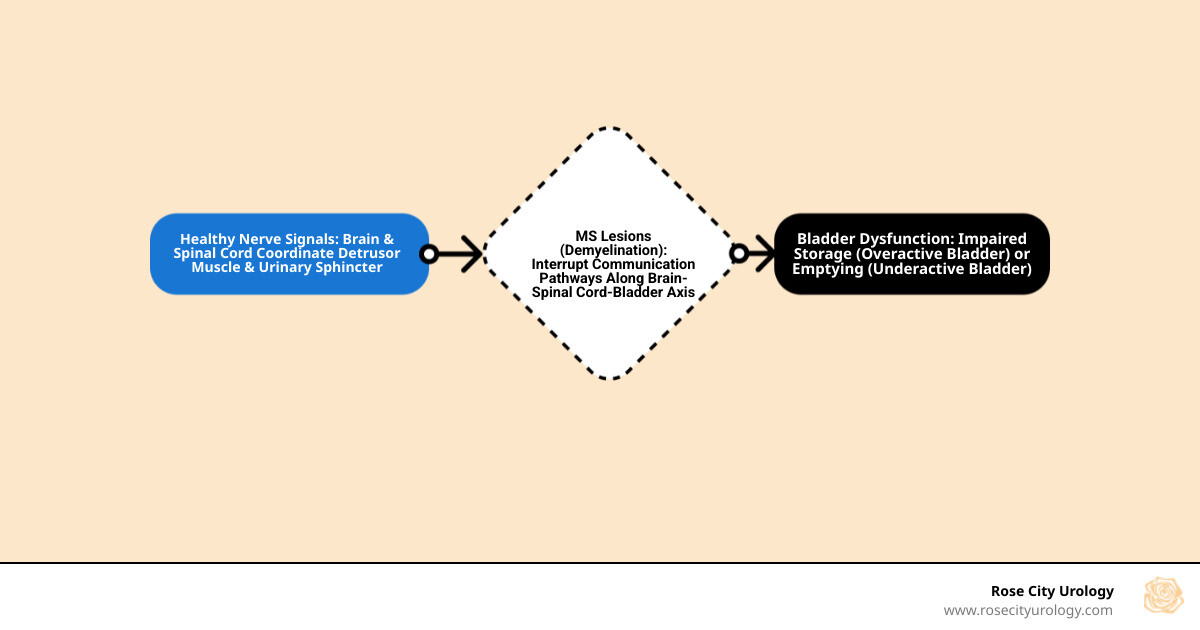
Bladder dysfunction occurs when MS lesions interrupt communication between your brain, spinal cord, and the muscles controlling your bladder—the detrusor muscle and urinary sphincter. This disruption means your bladder may contract too often, not empty completely, or both.
These symptoms can be embarrassing and impact quality of life, causing social isolation, anxiety, and disrupted sleep. Many with MS report that bladder issues affect their daily activities more than mobility problems.
But here's the important part: bladder dysfunction in MS is highly manageable. With the right assessment and treatment, most people can achieve better bladder control, reduce symptoms, and protect their long-term kidney health.
I'm Dr. Ryan Tubre, a board-certified urologist at Rose City Urology in Tyler, Texas. I specialize in neurogenic bladder conditions, including multiple sclerosis bladder dysfunction. I use conservative approaches and advanced techniques like robotic-assisted procedures and neuromodulation to create a personalized treatment plan that improves your quality of life.
Multiple sclerosis bladder terminology:
At Rose City Urology, we understand that MS bladder dysfunction is a neurological issue. The problem isn't the bladder itself but the communication network that controls it.
MS is a chronic disease of the central nervous system (brain and spinal cord). The immune system attacks the myelin sheath (the protective nerve covering), creating lesions (demyelination) that disrupt nerve signals.
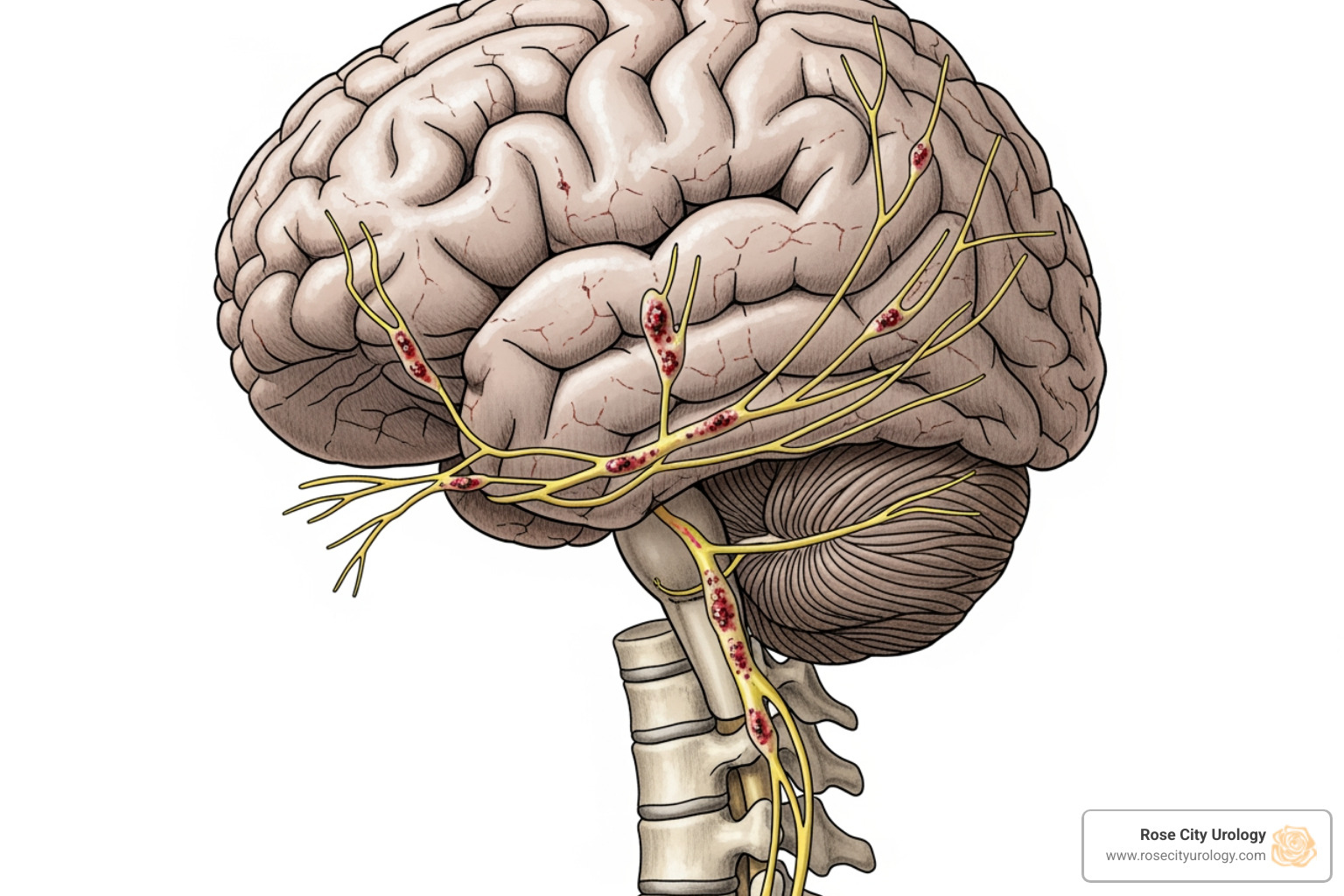
Imagine your bladder is a balloon with a faucet (the urinary sphincter). Your brain sends signals down the spinal cord telling the balloon (detrusor muscle) when to fill and squeeze, and the faucet when to open. In MS, lesions disrupt these crucial signals to the detrusor and sphincter muscles.
This lack of coordination leads to a condition known as neurogenic bladder. As experts in this condition, we know early assessment is essential to protect kidney health and improve your quality of life. Learn more about the mechanisms of neurogenic bladder from this article on The Epidemiology and Pathophysiology of Neurogenic Bladder.
MS bladder dysfunction typically causes problems with storing urine, emptying urine, or a combination of both.
A common issue is detrusor-sphincter dyssynergia (DSD), where the bladder muscle contracts while the sphincter stays closed. This is like squeezing a balloon with the nozzle shut, creating high pressure and making it hard to empty.
If unmanaged, nerve damage from MS has long-term implications. Chronic urine retention can put pressure on the kidneys, leading to damage over time. This is why early intervention is critical.
Common symptoms of multiple sclerosis bladder dysfunction include:
These symptoms help us understand the scope of the problem. For more information about urinary leakage and incontinence, please visit our dedicated page: More info about Urinary Leakage & Incontinence.
At Rose City Urology, we categorize multiple sclerosis bladder issues into three main types based on how the bladder stores or empties urine. This helps us create an effective treatment plan.
The main types are problems with bladder storage (hyperactive bladder) and bladder emptying (hypoactive bladder). Some individuals experience a combination of both.
Prevalence Statistics:
The overactive (hyperactive) bladder is the most common type in MS patients. It occurs when the detrusor muscle becomes overactive, causing involuntary contractions even when the bladder isn't full (detrusor hyperactivity).
What causes problems with bladder storage in MS?MS lesions interrupt nerve signals that tell the bladder to relax and fill. Consequently, even a small amount of urine can trigger strong, sudden contractions, causing:
The underactive (hypoactive) bladder affects about 20% of MS patients. This occurs when the bladder muscle doesn't contract effectively or the sphincter doesn't relax, making it hard to empty the bladder completely.
What causes problems with bladder emptying in MS?MS lesions interfere with nerve signals for bladder contraction and sphincter relaxation, leading to:
A hypoactive bladder is dangerous. Retained urine can back up into the kidneys, causing damage or serious infections.
Combined dysfunction involves both storage and emptying problems. For example, the bladder might spasm while the sphincter fails to relax. This complex issue requires a nuanced approach.
How can urinary tract infections (UTIs) be related to bladder problems in MS?UTIs are very common in people with MS, affecting about 80% of patients. This high rate is often directly linked to bladder dysfunction.
If you suspect a UTI, seek medical attention promptly. For more information, visit our page: More info about Urinary Tract Infections (UTIs).
Managing multiple sclerosis bladder dysfunction is a journey. At Rose City Urology, we use a comprehensive, multidisciplinary approach, working with your neurologist to align bladder care with your overall MS management.
What role does consulting a urologist play in managing MS-related bladder dysfunction?A urologist experienced in neuro-urology is a critical partner. We specialize in diagnosing the specific type of bladder dysfunction, ruling out other causes, and offering a wide range of treatments. Our focus is improving your quality of life while protecting your kidney health.
Our initial assessment includes discussing symptoms, reviewing medical history, and using a bladder diary. We may also recommend urodynamic testing to get detailed information on bladder function. This helps us identify the problem and set clear treatment goals with you.
The first line of defense involves lifestyle modifications and behavioral therapies. These simple strategies can significantly improve bladder control and are often recommended first.
What are the recommended initial steps for managing bladder issues in MS, such as behavior modification?What lifestyle modifications can help manage bladder symptoms in MS?
If lifestyle changes aren't enough, medications can help manage multiple sclerosis bladder symptoms by relaxing an overactive bladder or helping it empty.
What medications are commonly used to treat bladder issues in MS, and how do they work?
| Medication Class | How They Work | Primary Use | Examples (Generic) |
|---|---|---|---|
| Anticholinergics | Block nerve signals that trigger involuntary bladder contractions, helping the bladder relax and hold more urine. | Overactive bladder, urgency, frequency, incontinence | Oxybutynin, Tolterodine, Trospium, Darifenacin, Solifenacin, Fesoterodine |
| Beta-3 Agonists | Activate beta-3 receptors in the bladder muscle, causing it to relax and increase its capacity to store urine without increasing contractions. | Overactive bladder, urgency, frequency, incontinence | Mirabegron |
| Desmopressin | Reduces the amount of urine your kidneys make, particularly at night. | Nocturia (nighttime urination) | Desmopressin (requires careful monitoring) |
| Alpha-blockers | Relax the muscles in the bladder neck and prostate (in men), making it easier for urine to flow. | Impaired emptying due to outlet obstruction | Terazosin, Tamsulosin (primarily for men or for detrusor-sphincter dyssynergia) |
We prescribe medications based on your specific symptoms and monitor for side effects.
For symptoms that don't respond to initial therapies, we offer advanced interventions that can provide significant relief.
What non-pharmacological interventions are available for impaired bladder storage?Advanced interventions include:
What urological procedures can be used to treat detrusor hyperactivity?Besides Botox and neuromodulation, augmentation cystoplasty (surgically enlarging the bladder) is an option for very severe, refractory cases. These treatments are part of a comprehensive strategy, as detailed in this review: Management of neurogenic bladder in patients with multiple sclerosis.
Addressing problems with bladder emptying is crucial to prevent serious complications.
How is impaired emptying due to detrusor hypoactivity treated?
How is impaired emptying due to outlet obstruction treated?If emptying is impaired by an outlet obstruction like detrusor-sphincter dyssynergia, options include:
What are the indications for intermittent catheterization and urinary diversion procedures in MS patients?
What are the potential complications of untreated bladder dysfunction in MS?Untreated bladder symptoms can lead to serious health consequences:
We understand that living with MS brings many questions about bladder health. Here are some common ones we address at Rose City Urology:
You should consult a urologist for any MS-related bladder symptoms, especially if:
While bladder problems can occur early in MS, they are rarely the sole initial symptom. They usually appear with other neurological symptoms like vision changes, numbness, or weakness. If you have new, unexplained bladder symptoms, especially with other neurological signs, a full workup is important to find the cause.
The most significant complication of untreated multiple sclerosis bladder dysfunction is potential kidney damage. Chronic urine retention, high bladder pressures, and reflux (urine backing up to the kidneys) can cause hydronephrosis (kidney swelling) and, in severe cases, permanent kidney failure. Recurrent, severe infections (urosepsis) are also a major threat. Our primary goal in managing MS bladder issues is to protect your kidneys from long-term damage.
Living with multiple sclerosis bladder dysfunction is challenging, but it doesn't have to define your life. At Rose City Urology, our goal is to empower you with knowledge and effective treatments to help you regain control and improve your quality of life.
We've discussed how MS disrupts bladder control and the range of management strategies available, from lifestyle changes to advanced procedures like Botox injections and neuromodulation. The key takeaway is that these symptoms are treatable, and proactive management is essential for your comfort and long-term kidney health.
At Rose City Urology in Tyler, Texas, we provide personalized, patient-centered care. Our team uses advanced technology in a supportive environment to create the best treatment plan for your needs. Don't let bladder issues hold you back. Let us help you steer these challenges with expertise and compassion.